
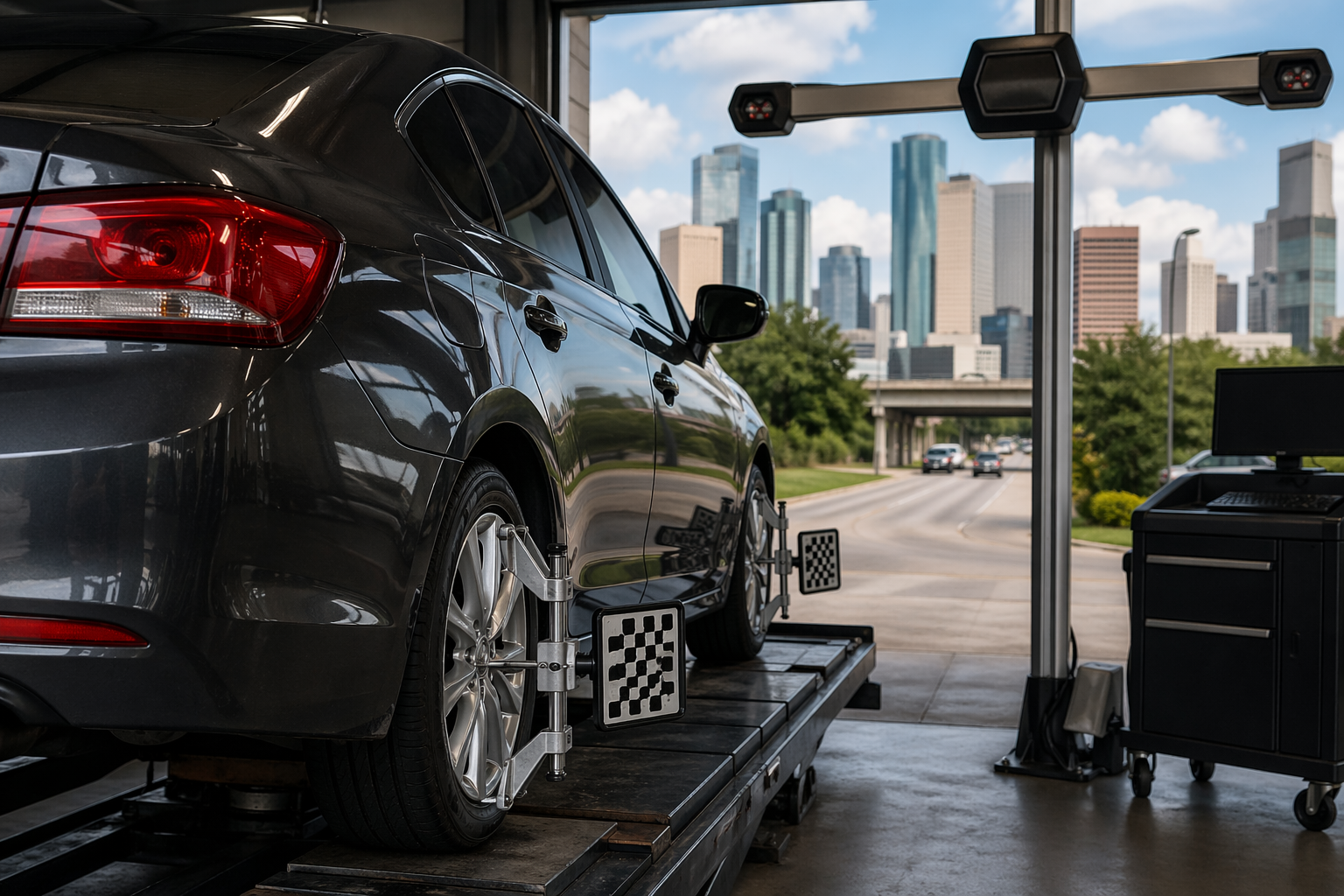
Why ADAS calibration after wheel alignment in Porter TX is critical for Houston drivers
A driver from Kingwood hit a pothole and scheduled a routine wheel alignment. A few days later, while driving on I-69, their lane assist started drifting—slightly pulling toward the edge of the lane. No warning lights. No obvious problem. Just a subtle issue that could have turned into a serious safety risk.
This is more common than most drivers realize. At highway speeds, these small corrections can feel delayed or inconsistent, especially in heavy Houston traffic where precise lane positioning matters. What makes this situation more concerning is that the vehicle may still feel “mostly fine,” which leads many drivers to assume nothing is wrong.
In reality, modern ADAS systems depend on exact alignment between the vehicle’s physical direction and what the sensors believe is happening. When those two don’t match, even slightly, the system begins making incorrect decisions.
At Houston ADAS, technicians regularly see vehicles that were properly aligned—but never recalibrated. Using OEM procedures, OE software, and a controlled indoor calibration facility, safety systems are restored to the exact specifications intended by the manufacturer.
If you’ve recently had alignment or suspension work and are searching for ADAS calibration near me, understanding how these systems are affected is essential to staying safe on Houston roads.
Can a wheel alignment throw off ADAS systems?
Yes, and it happens more often than most drivers expect. A wheel alignment changes the relationship between the vehicle’s wheels and its centerline, which directly affects how ADAS sensors interpret direction and position.
Even when the alignment is performed correctly, the vehicle’s geometry has been adjusted. That means the reference point the system was originally calibrated to is no longer accurate. Cameras may interpret lane position slightly off-center, and radar sensors may misjudge distance relative to surrounding vehicles.
In many cases, drivers won’t notice a major issue right away. Instead, they experience subtle behaviors like small steering corrections or delayed responses from driver-assist systems. These are early signs that recalibration is needed after alignment changes.
Why wheel alignment and suspension repairs require ADAS calibration in Porter TX vehicles
Many drivers assume that once a wheel alignment is completed, the vehicle is fully corrected. Mechanically, that may be true—but electronically, it often is not.
ADAS systems rely on the vehicle’s thrust angle and centerline alignment to determine where the car is actually traveling. When alignment adjustments are made, even small changes affect toe, camber, and caster. These changes alter the vehicle’s true path, which directly impacts how forward-facing cameras and radar sensors interpret the road.
For example, a rear alignment adjustment changes the thrust line. Even a small deviation can cause the vehicle to track slightly off-center relative to the lane. While this may not be noticeable to the driver, the ADAS system detects it immediately and begins compensating incorrectly.
Suspension work compounds the issue. Replacing struts, control arms, or other components can change ride height and shift sensor positioning. Because ADAS systems are calibrated to very tight tolerances, even minor changes can disrupt accuracy.
That’s why many manufacturers require recalibration as part of post-repair procedures. Without it, the system is essentially working with outdated reference points.
What happens if you skip ADAS recalibration after wheel alignment in Porter TX
Skipping calibration after alignment can create a disconnect between what the vehicle is doing and what the system believes is happening.
In real-world driving, this often shows up as subtle but persistent issues. The vehicle may drift within the lane, make small overcorrections, or react inconsistently to surrounding traffic. These problems tend to become more noticeable at highway speeds, where precision matters most.
Drivers frequently report lane assist drifting, steering that feels slightly off, or forward collision warnings that seem delayed or overly sensitive. In many cases, these issues are not caused by faulty parts—they are the result of miscalibrated sensors.
One of the most concerning aspects is that these systems typically do not trigger warning lights when misaligned. The vehicle appears to be operating normally, which creates a false sense of security.
Signs your ADAS system needs calibration after alignment or suspension work near Porter TX
After alignment, your vehicle may not show obvious signs of a problem, but there are subtle indicators that something isn’t right.
You might notice that the steering wheel is slightly off-center even though the vehicle tracks straight. Lane assist may drift or make small, unnecessary corrections. Adaptive cruise control may behave inconsistently, especially in stop-and-go traffic.
These symptoms are often dismissed as normal post-alignment adjustments, but they usually indicate that the ADAS system has not been recalibrated. The key difference is that mechanical alignment issues typically affect how the vehicle feels, while calibration issues affect how the vehicle responds through its safety systems.
Paying attention to these early signs can prevent larger problems down the road.
Is it normal for lane assist to feel off after wheel alignment in Porter TX
It is normal for steering feel to change slightly after alignment, but driver-assist systems should not behave differently.
If lane assist begins drifting, making jerky corrections, or responding inconsistently, that is not part of the normal adjustment process. These behaviors indicate that the system’s reference points no longer match the vehicle’s actual movement.
In simple terms, the car may be driving straight, but the system thinks it isn’t—or vice versa. This mismatch leads to incorrect corrections, which can be frustrating at best and dangerous at worst.
If you notice any change in how these systems behave after alignment, it is a strong indication that recalibration is needed.
How suspension geometry, ride height, and tire conditions affect ADAS calibration in Houston area vehicles
ADAS systems are highly sensitive to the physical condition of the vehicle. Changes in suspension geometry, ride height, and tire condition all play a role in how accurately sensors function.
Ride height changes—even small ones—alter the angle at which cameras and radar sensors are positioned. Suspension repairs can shift these angles further, especially if components like struts or control arms are replaced.
Tires also play a larger role than most drivers expect. Differences in tire size, uneven wear, or incorrect pressure can change how the vehicle sits and moves, which directly impacts sensor alignment.
What many drivers don’t realize is that ADAS systems are calibrated to the vehicle’s exact position at a specific moment. Any change after that point—no matter how minor—can affect how the system interprets the road.
How steering angle sensor and thrust angle affect ADAS calibration in Porter TX vehicles
Two critical factors in ADAS calibration are the steering angle sensor and the thrust angle.
The steering angle sensor tracks the direction of the steering wheel and helps the system understand where the driver intends to go. After alignment, this sensor must be reset so it reflects the vehicle’s new geometry.
The thrust angle, determined by rear wheel alignment, defines the vehicle’s true forward path. If the thrust angle is off, the vehicle may travel slightly sideways even if the steering wheel appears straight.
When these two measurements are not aligned, the ADAS system receives conflicting information. This can result in incorrect lane positioning, delayed responses, and inconsistent system behavior.
How OEM ADAS calibration is performed after alignment in a controlled lab in Porter TX
Once alignment is complete, calibration ensures that all sensors are correctly aligned with the vehicle’s new geometry.
The process begins with verifying that the vehicle meets all preconditions, including proper tire pressure, ride height, and alignment accuracy. Technicians then position calibration targets at precise distances and align them with the vehicle’s centerline.
Using OEM tools, the system is recalibrated so that cameras and radar sensors correctly interpret their surroundings, with adjustments performed by an experienced ADAS calibration team. In some cases, dynamic calibration is also required, where the vehicle is driven under controlled conditions to finalize adjustments.
In the Houston area, factors like road quality, traffic density, and frequent potholes make accurate calibration even more important. A controlled indoor environment eliminates variables like uneven surfaces and lighting conditions, ensuring consistent results.
What causes ADAS calibration to fail after alignment (and what happens when it does)
Even when alignment is performed correctly, skipping calibration or doing it improperly can lead to serious issues.
Common problems include lane drift, false alerts, and missed hazards. These issues often stem from incorrect target placement, inaccurate measurements, or failure to follow OEM procedures.
In real-world driving, these errors may not be obvious immediately. However, over time, they can affect how the vehicle responds in critical situations. This is especially important in high-traffic areas like Houston, where quick and accurate system responses are essential.
ADAS calibration cost after wheel alignment in Porter TX
Calibration costs vary depending on the vehicle, the number of systems involved, and whether both static and dynamic procedures are required.
Most calibrations take between one and four hours to complete. For many drivers, the process can be completed the same day once alignment is verified.
While cost is an important consideration, it should not be the deciding factor. Skipping calibration to save money can lead to far more expensive problems if the system fails to respond correctly in a critical situation.
Which repairs require ADAS calibration after suspension or alignment work in Porter TX
ADAS calibration is required more often than many drivers expect.
Any service that affects alignment angles, ride height, or sensor positioning should be evaluated for recalibration. This includes wheel alignments, suspension repairs, steering component replacement, and ride height adjustments.
Not every repair requires calibration, but many do. The safest approach is to have the system inspected after any work that changes how the vehicle sits or moves.
When ADAS calibration was missed after alignment in Porter TX
A driver from Kingwood had a standard alignment after hitting a pothole. Shortly after, they noticed that lane assist began drifting and steering felt inconsistent.
Inspection revealed that while the alignment was completed correctly, the ADAS system had not been recalibrated. After proper calibration in a controlled environment, system performance returned to normal and the vehicle tracked correctly within the lane.
This type of situation highlights how easy it is for calibration to be overlooked—and how important it is to address it.
How to choose a certified ADAS calibration center near Porter TX
Choosing the right calibration center plays a major role in ensuring accurate results.
A qualified facility should follow OEM procedures, use proper equipment, and perform calibration in a controlled indoor environment. Post-calibration verification is also critical to confirm that the system performs correctly in real-world conditions.
In practice, most calibration issues are caused by setup and environmental factors rather than equipment. Even advanced tools cannot compensate for poor positioning or uncontrolled conditions.
Service areas for ADAS calibration near Porter TX and Greater Houston
Houston ADAS works with drivers throughout Porter, Kingwood, Humble, New Caney, and nearby areas. The shop also supports local repair facilities that rely on accurate calibration before returning vehicles to customers.
FAQs about ADAS calibration after alignment in Porter TX
Do I need ADAS calibration after wheel alignment?
Yes. Alignment changes the vehicle’s geometry, which affects sensor accuracy.
Can alignment affect lane assist?
Yes. Even small changes impact how the system tracks lanes.
Why does my steering feel off after alignment?
It may be a calibration issue rather than the alignment itself.
What is a steering angle sensor reset?
It recalibrates the system to understand the vehicle’s direction.
How long does calibration take?
Typically one to four hours.
Schedule ADAS calibration after alignment in Porter TX
For drivers like the one in Kingwood, the issue wasn’t obvious until it started affecting real driving conditions. Don’t assume your vehicle is safe just because it was aligned. Proper calibration ensures that all driver-assist systems function as intended.
Houston ADAS provides precise calibration in a controlled environment, helping drivers maintain accurate and reliable safety systems.
Location:
22321 E Martin Dr, Suite B, Porter, TX 77365
Call:
281-354-8777
Connect:
Final thought on ADAS calibration after alignment
When steering and suspension changes affect how the vehicle tracks, the systems that depend on that tracking must be adjusted as well. Proper calibration ensures the system responds accurately when it matters most in real driving conditions.

With over three decades of management and operational experience, David Evans has built Houston ADAS from the ground up, focusing on precisely calibrating ADAS systems. His leadership is guided by a passion for automotive safety and a deep understanding of the ADAS landscape. David is not just a visionary; he’s a hands-on leader with I-Car ProLevel 1 and 2 ADAS certifications, ensuring he stays connected to the core operations of his business.